
How to Trade Gold CFDs: A Practical Guide for South Africans
A step-by-step walkthrough of trading gold CFDs with FxPro from South Africa, covering everything from contract basics to placing your first trade with disciplined risk management.
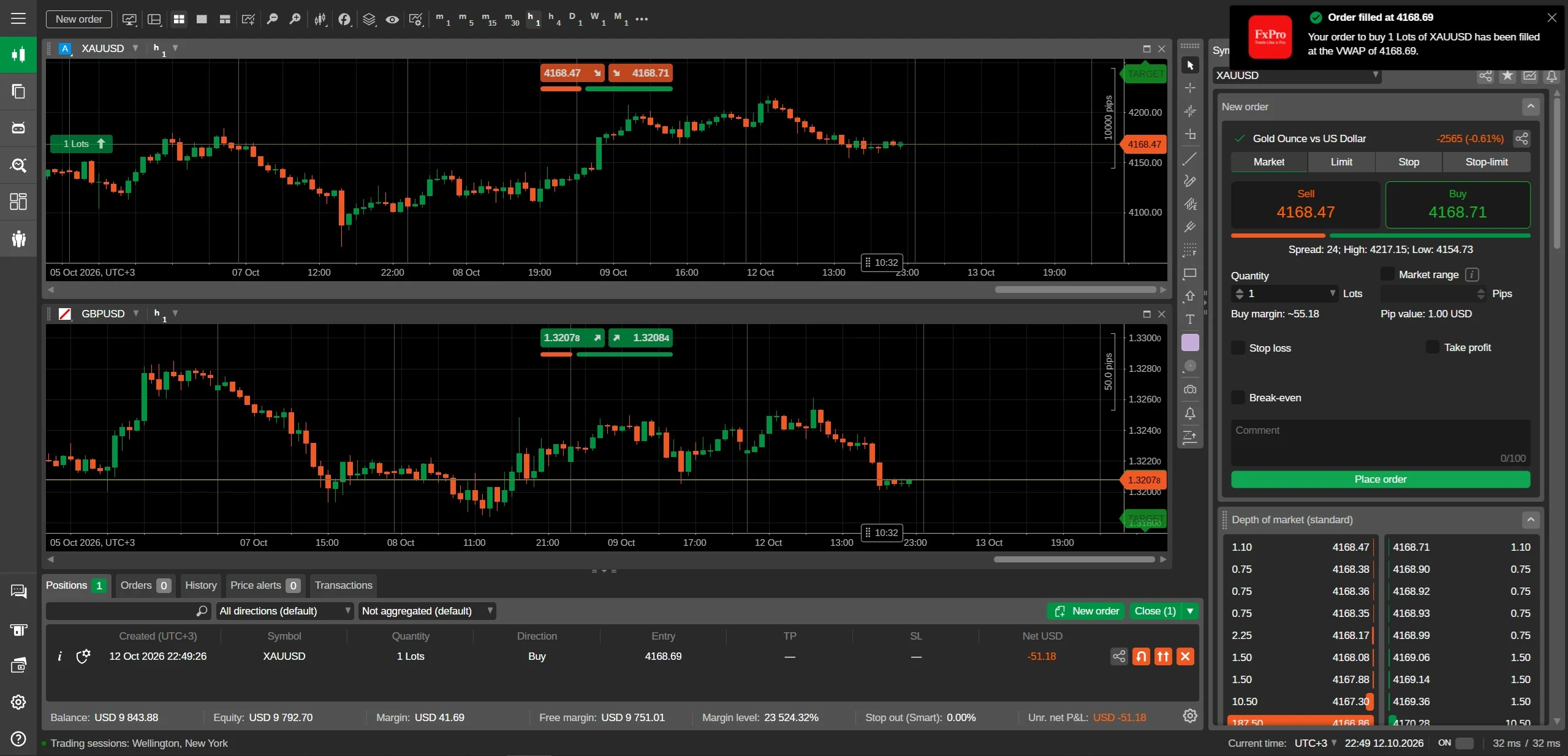
What Is Gold CFD Trading?
Gold CFD trading lets you speculate on the price of XAU/USD without owning physical bullion. You open a contract for difference with a broker like FxPro, and your profit or loss is the difference between entry and exit price multiplied by the number of ounces traded. In South Africa, this means you can trade gold priced in US dollars while funding your account in rand.
A CFD is a leveraged derivative, so you only put down a fraction of the full position value as margin. This magnifies both gains and losses, making it essential to understand the contract size and pip value before trading. Gold is traded globally around the clock, which suits South African traders who want flexibility outside local market hours.
Understanding Gold Contract Size and Pip Value
One standard lot of gold (XAU/USD) equals 100 troy ounces. A one-pip move is 0.01 in price, which means a 0.01 change in gold is worth $1 per standard lot. For example, if gold moves from 4275.00 to 4275.01, that is one pip and equals $1 profit or loss on a 1.00-lot trade.
FxPro allows fractional lots, so you can trade 0.10 lots (10 ounces) or 0.01 lots (1 ounce). At 0.10 lots, one pip is worth $0.10. This flexibility helps South African traders manage rand-equivalent risk, especially when the ZAR/USD exchange rate fluctuates. Always confirm the contract specifications on your platform before opening a position.
Leverage and Margin in Gold Trading
Leverage lets you control a large gold position with a small margin deposit. FxPro offers leverage up to 1:500 on gold, meaning a 0.10-lot position (10 ounces) at a gold price of $4275 requires approximately $85.50 in margin. That margin is held by the broker while the trade is open.
High leverage increases both potential profit and potential loss. A 1% adverse move in gold against a 1:500 leveraged position can wipe out most of the margin. South African traders should convert margin to rand to understand the actual capital at risk, and never use maximum leverage simply because it is available.
Sizing Positions to a Fixed Rand Risk
The core discipline is to risk a small, fixed percentage of your account on each trade, usually 1% to 2%. Calculate your position size based on the distance from entry to stop-loss, not on how much you want to make. For gold, if you risk R500 and your stop is 50 pips away, you trade a size where 50 pips equals R500.
To do this precisely, convert your rand risk to US dollars using the current exchange rate, then divide by the pip value per lot. For example, if R500 is roughly $27 and each pip on 0.10 lots is $0.10, a 50-pip stop would allow a 0.54-lot position (27 / (50 x 0.10)). Always round down to be safe.
This method keeps losses survivable and removes emotion from position sizing. It is especially important for South Africans because rand volatility can change your effective risk, so recalculate whenever the exchange rate moves significantly.
The Real Cost: Spread and Overnight Swap
Gold CFD trading has two main costs: the spread and the overnight swap. The spread is the difference between the buy and sell price, and FxPro prices gold with a spread; whether a commission applies depends on the account type. This cost is paid on every trade, so a wider spread eats into your profit from the first pip.
The overnight swap is a financing charge or credit applied if you hold a gold position past 22:00 South African time. It is calculated on the full position value and varies daily. For South African traders, holding a long gold position overnight typically incurs a swap charge, so factor this into your trade plan if you intend to hold for days or weeks.
Placing a Stop and Managing the Trade
A stop-loss order is non-negotiable for gold trading because volatility can spike on news or during illiquid hours. Place your stop based on market structure, such as below a recent swing low for a long trade, not on an arbitrary rand amount. This gives the trade room to breathe while capping your risk.
Once the trade is live, avoid micromanaging. Set a take-profit at a logical resistance level or use a trailing stop to lock in gains as the price moves in your favour. Gold often trends strongly, so letting winners run with a trailing stop can be more profitable than exiting early out of fear.
Common Beginner Mistakes on Gold CFDs
The most common mistake is overleveraging—using maximum leverage because it is available. A 1:500 leveraged gold trade can be wiped out by a move of just a few dollars. Another mistake is ignoring the swap cost, which quietly drains accounts on positions held for weeks.
Beginners also trade gold without a stop-loss, hoping the price will turn around. Gold can trend for long periods, and a reversal may come too late. Finally, many South African traders fail to convert their risk to rand, leading to position sizes that are far larger than intended once the exchange rate is considered.
A Realistic First Trade Walk-Through
Assume your FxPro account is funded with R10,000 and you want to risk 2% (R200) on your first gold trade. You identify a long setup at $4275.00 with a stop at $4270.00, a 500-pip risk. Convert R200 to USD (approximately $11 at R18/USD), then calculate size: 500 pips x $0.10 per pip on 0.10 lots = $50 risk per 0.10 lots, so you can trade only 0.02 lots to risk about $10.
You enter 0.02 lots long at $4275.00. Your margin required is about $17.10 (0.02 x 100 oz x $4275 / 500). The spread is a few pips, so your position starts slightly negative. You set a take-profit at $4285.00 (1000 pips away) for a potential gain of $20. If the stop is hit, you lose about $10, which is R180—within your risk limit. You monitor the trade but do not move the stop further away.
Your First Week on a Demo Account: What to Actually Test
Your first week on a demo account should test one thing at a time, not try to feel like live trading. Start by executing 20 market orders on XAU/USD in MT4, MT5, cTrader, or FxPro Edge, and record how long each takes from decision to fill. Gold moves fast, and a two-second delay in clicking can be the difference between a clean entry and chasing the price. Then place 20 pending orders, half buy stops and half sell stops, and watch how they trigger when price approaches 4275.0, the reference level you were given.
Test how a 0.10-lot position behaves with the maximum retail leverage of 1:200, because that requires about $85.50 in margin, a small enough amount to feel real but not reckless. You will see that the margin requirement does not change when gold moves R10 or R20 against you; only your floating loss does. This is the week to learn that the platform does not warn you politely before margin calls happen, so you need to know your free margin number at all times, not just your profit and loss.
Finally, test the mechanics of partial closes and moving a stop loss to break even, because these are the actions you will take repeatedly on a live account. On MT4 and MT5, right-click the open position and choose close or modify; on cTrader, use the trade panel; on FxPro Edge, the web interface has similar buttons. Spend one full day on each platform if you can, because switching later costs time and mistakes, and time is the one thing a demo account gives you for free.
Keeping a Gold Trade Journal That Actually Helps You Improve
A useful trade journal records your reasoning before the trade, not just the outcome after it. For every XAU/USD position, write down the exact time, the direction, the entry price, the stop loss in pips, and the reason you entered in one sentence. If you cannot write the reason before clicking buy or sell, you do not have a trade; you have a gamble. The reason can be as simple as a breakout above a level you had marked, but it must exist and it must be written.
After the trade closes, write the result in rands, not just pips, because the rand amount is what affects your actual account. If your account is funded in ZAR through a local card or EFT, the platform converts your dollar profit or loss automatically, but your journal should force you to think in rand terms. A 10-pip loss on 0.10 lots is R2.14 at 1 pip = $0.10 and a rate of about R21.40 to the dollar, but do not calculate that in your head; let the platform do it and write down the number you see.
Review the journal every Friday and count how many trades followed your plan exactly, how many were revenge trades, and how many were taken because you were bored. The rule is simple: if the reason column is empty or says 'felt like it', the trade does not count as a real trade, no matter how much money it made. Over a month, you will see that your profitable trades cluster around one or two setups, and that is the edge you should focus on, not the random wins.
Position Sizing as a Habit, Not a Calculation
Position sizing becomes a habit when you decide your risk in rands before you look at the chart, not after you see an exciting move. For gold, one standard lot is 100 oz and one pip is 0.01, so a 10-pip stop on a full lot risks $10, which is about R210 at a typical rate. If your account is R50,000 and you are willing to risk 1% per trade, that is R500, meaning your maximum stop distance on a full lot is about 24 pips. Do that math once, write it on a sticky note, and never recalculate it during market hours.
The habit is to always enter the lot size first and the entry price second. In MT4, MT5, cTrader, or FxPro Edge, open the order window, type your lot size based on the rand risk you already decided, and only then place your stop where the chart says the trade is wrong. If the stop distance is larger than your pre-set limit, you do not reduce the lot size as a compromise; you skip the trade. That is the discipline that keeps a losing streak from wiping out a month of work.
Leverage is not part of the position sizing habit; it is only a margin cap. With maximum available leverage up to 1:200 for retail clients in South Africa, a 0.10-lot position needs about $85.50 in margin, but that does not mean you should use 1:200. Your lot size is determined by rand risk and stop distance, and the margin requirement just tells you the minimum free margin you need. Keep your used margin under 20% of your account equity, and the habit will protect you from the single mistake that ends most gold trading accounts: one oversized trade.
The Three Most Expensive Beginner Mistakes and the Rule That Prevents Each
The first expensive mistake is moving a stop loss further away after the trade goes against you, and the rule that prevents it is to set the stop before you enter and never touch it except to reduce risk. Gold can move R50 in an hour, and each R1 move on 0.10 lots is R0.21, so a widened stop can turn a planned R50 loss into R200 in minutes. The moment you think about moving the stop, ask yourself if you would enter the trade now at the current price; if not, close it and accept the planned loss.
The second expensive mistake is averaging down, which means adding to a losing position because the price is 'cheaper'. The rule that prevents it is one entry per trade idea: if the trade is still valid, you do not need a second entry; if it is no longer valid, you should not have the first one. Adding to a loser on gold with 1:200 leverage multiplies your margin requirement and your risk at the worst possible time. A 0.10-lot loser that you double into becomes a 0.20-lot loser with $171 in margin instead of $85.50, and a stop that was 20 pips away is now 10 pips away from a much bigger loss.
The third expensive mistake is trading without a daily loss limit, because a single bad hour can undo a week of discipline. The rule that prevents it is to set a rand amount you are willing to lose in a day, such as 2% of your account, and log out of the platform when you hit it. On MT4 and MT5 you can set a daily loss limit in the terminal settings; on cTrader and FxPro Edge, use a manual alarm or a simple sticky note. Gold trades nearly 24 hours, and the temptation to recover losses at midnight is the most expensive habit of all, because you are trading tired, emotional, and against the odds.
Move from reading to trading
FxPro gives South African traders MT4, MT5, cTrader and a mobile app on MT4, MT5, cTrader and a mobile app. FxPro is licensed by the FCA (UK) and CySEC, and an FxPro entity holds an FSCA licence in South Africa — check which entity your own account is opened with.
Review FxPro execution →