
Opening a live FxPro account for gold trading from South Africa
The account form takes under ten minutes once you know which account type, base currency and leverage you want.
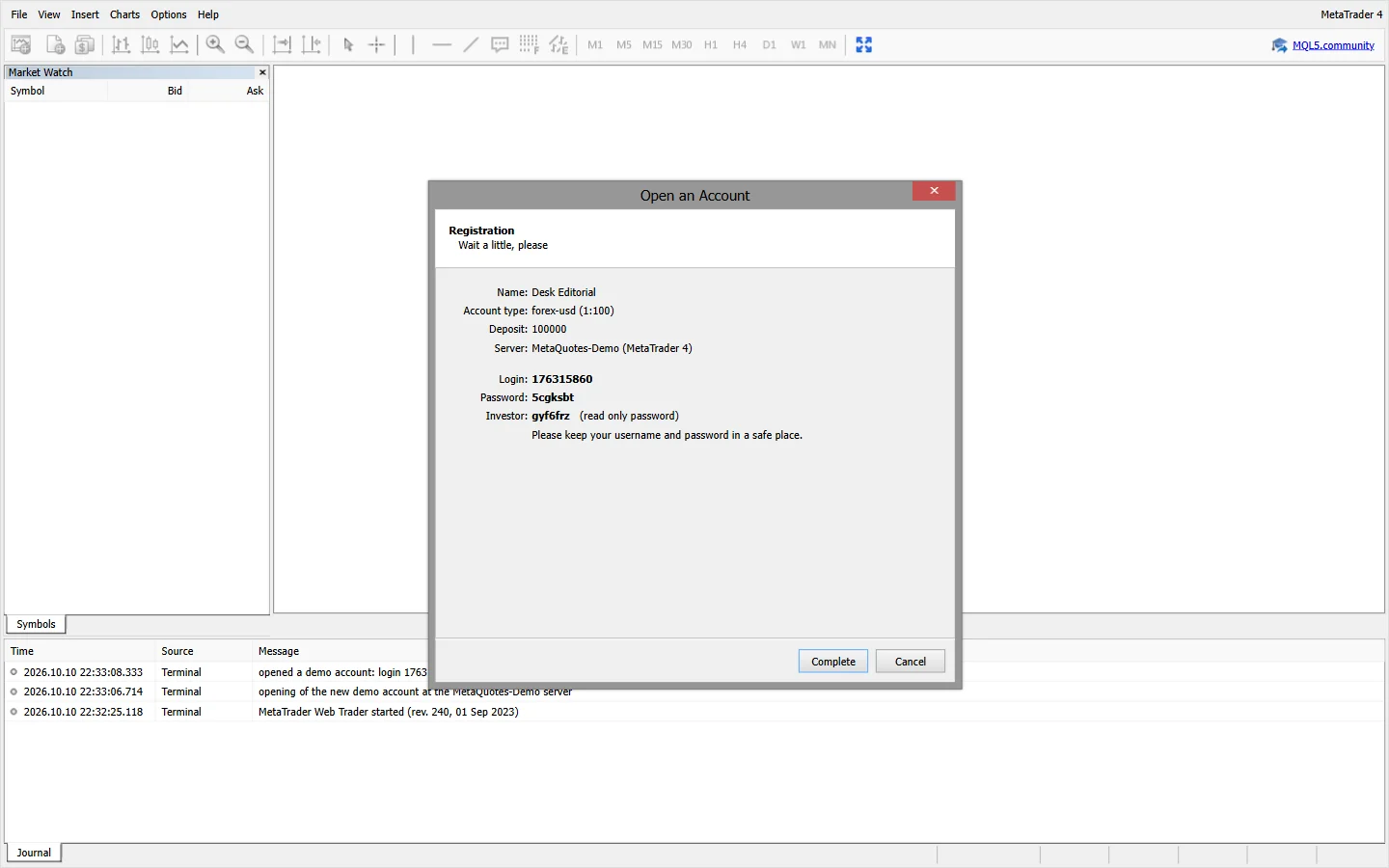
What the application asks, in order
The FxPro online form first collects your country of residence, email and phone number, then asks you to set a password and choose your trading platform preference from MT4, MT5, cTrader or FxPro Edge. You will then answer a short financial questionnaire about your trading experience and income source, because this determines the leverage you are offered later in the process. The final step is a declaration that you accept the client agreement and risk disclosure, after which the system creates a client area where you can access your account number.
You do not need to deposit during sign-up, and the form does not ask for your ID yet — verification is a separate step after the account exists. If you are unsure about any question, leave the form open and check our gold margin calculator first, because the leverage decision affects the margin you will need on XAU/USD. The questionnaire is not an exam; honest answers simply match you to the right regulatory leverage category under FSCA rules.
Three decisions to settle before you start
Account type comes first. FxPro offers Standard, Raw+, cTrader, Elite and VIP accounts, and for most South African gold traders the Standard account is the natural starting point because it has no commission and a low entry around R1,600. Raw+ and cTrader charge a per-lot commission in exchange for raw spreads, which can suit higher volume traders, but you should check the current cost structure on the broker’s site before choosing. The questionnaire sets the leverage you are offered, and that directly changes the margin you must hold for a gold position.
Base currency matters more than it first appears. FxPro supports a ZAR account currency, which lets you fund by local EFT and see your balance in rand without conversion on every deposit, so choose ZAR during the application. Leverage is the third decision: retail clients get up to 1:200, while eligible professional clients may be offered up to 1:500 depending on the instrument. At 1:200, a 0.10-lot gold position with XAU/USD near 4275.0 requires about R3,200 margin; use our margin calculator to see the exact rand requirement before you commit.
Avoiding the second attempt
The most common reason South Africans restart the FxPro application is choosing USD as the base currency and then realising they cannot fund by plain EFT without a conversion. Select ZAR on the account creation screen, and your local bank transfer goes through without a currency switch. The second common error is picking a platform you have never used; if you are new to gold trading, start with MT4 or MT5 because most charting and order tutorials are written for them, or use the FxPro app for simple order entry.
Check that the entity serving your account is the one that holds the FSCA licence. FxPro is licensed by the FCA (UK) and CySEC, and an FxPro entity holds an FSCA licence in South Africa — check which entity your own account is opened with. The onboarding process may route some South African applications through an offshore entity, so look for the legal entity name in your client area and confirm it is the FSCA-authorised one if that matters to you. Completing verification before your first deposit avoids a frozen withdrawal later.
The country field fixes your legal entity and payment rails
Your country selection determines which FxPro entity will legally hold your account, and that is not a cosmetic label. For South Africa, accounts may be opened with FxPro Markets Direct Costa Rica Latam SRL, but the FCA- and CySEC-licensed entities also accept clients from the region under their own terms. Each entity has its own client agreement, dispute process, and compensation scheme, so the country field decides which rulebook applies to your money before you ever fund the account.
The country field also controls which payment methods appear later in the application. A South African address unlocks ZAR-denominated bank transfer and local card deposits, and e-wallet options where they are supported by the payment processor. Selecting a different country from the one where your bank account is domiciled will remove those local rails and can trigger extra verification, because the broker must reconcile the country you claim with the proof-of-address document you upload.
Changing the country later is not a simple edit. The field is locked to the entity and payment corridor selected at onboarding, so a move abroad or a mistaken entry usually means opening a fresh account under the correct jurisdiction. Before you click through, confirm that the country shown matches the address on your utility bill or bank statement, because a mismatch here is one of the most common reasons an application is sent back for a second attempt.
Account type at sign-up is about execution, not different prices
At the moment of opening, the account type you pick mainly sets which trading platform and execution model you will use, not a different spread schedule. FxPro offers MT4, MT5, cTrader, and the proprietary FxPro Edge, and the application asks you to choose the platform before you can proceed. The underlying gold market is the same; what changes is how orders are routed, which charting tools you get, and whether you are on a market execution or instant execution environment.
The account type also decides the default currency of your trading account, which matters for gold because XAU/USD is quoted in US dollars. If you open a ZAR-based account, your rand balance is converted at the prevailing rate for margin and P&L, while a USD account keeps everything in the quote currency. You can hold multiple account types under one client profile, but each one is a separate wallet, so choosing the wrong base currency at sign-up means funding and withdrawing from two places until you close one.
Do not expect the account type to change your leverage cap or your protection tier. In South Africa, retail clients can access up to 1:200 leverage on gold, while eligible professional clients may be offered up to 1:500, but that is set by your classification and the instrument, not by the platform choice. The account type is a workflow decision: pick the platform you will actually trade on, and let the entity and leverage follow your client categorisation.
These details are locked once your account is live
Your base currency cannot be changed after the account is opened. If you selected a ZAR-denominated wallet and later want to trade gold in a pure USD environment, you must open a second account with the correct base currency and transfer funds between them. The same applies to the platform: an MT4 account cannot be switched to cTrader or MT5, because each platform runs on a separate server and trade history cannot be migrated.
The legal entity behind the account is also fixed. If you opened under the Costa Rica entity and later want the FCA- or CySEC-regulated entity, you cannot simply move the same account across. You would need to close positions, withdraw funds, and submit a new application under the desired jurisdiction. The country field you chose at the start is therefore a one-way door for that specific account number.
Client categorisation is not a setting you can toggle yourself. Retail versus professional status is assessed by the broker based on your experience, assets, and trading history, and once assigned, it stays with your profile until you reapply and meet the criteria. If you are classified as retail, the 1:200 cap on gold applies; if you later qualify as professional, the higher leverage of up to 1:500 is offered on a new or converted profile, not by editing the existing account.
Step-by-step timing: from form to first trade
Filling in the application itself takes under ten minutes if you have your ID and proof of address ready. The form asks for personal details, the country field, platform choice, and base currency, and each screen saves your progress. There is no fee to open an account, and you are not committed to funding until after approval, so the time cost is purely administrative at this stage.
Verification is the variable that can stretch from minutes to a full business day. If your uploaded documents are clear and the country field matches your proof of address, automated checks often approve the account within a few hours. A mismatch, a blurred ID scan, or a proof-of-address document older than three months triggers a manual review, which is where most delays come from.
Funding speed depends on the method, not the account opening. Local bank transfers in ZAR can take one to two business days to reflect, while card deposits are usually instant but may carry a processing fee from the card issuer. E-wallet funding is typically immediate once the wallet is linked. You can open and verify the account first, then fund when you are ready, because the account remains active without a deposit.
What you can safely ignore at the application stage
You do not need to decide on a spread, commission, or swap rate while opening the account. Those costs are determined by the live market and your account type once you trade, and they are not part of the sign-up form. The application asks only for platform, base currency, and country; it will not show you a fee schedule before you are approved, and you are not locking in any cost by proceeding.
Leverage selection is not a field you must fill in. The platform sets the maximum leverage for your client category and instrument automatically, and you can later choose a lower effective leverage through your position sizing. The margin required for a 0.10-lot gold position at 1:200 is about $85.50, but that figure is a consequence of the leverage cap, not a setting you pick during onboarding.
You can ignore any bonus or promotion prompts if they appear. The application does not require you to accept a bonus to open an account, and any bonus terms would be sent to you separately after approval. Focus on getting the country field, platform, and base currency right the first time, because those are the only decisions that are difficult to reverse later.
What the country field actually decides
Selecting South Africa in the country field directs your application to the FxPro entity that can legally serve you, which is FxPro Markets Direct Costa Rica Latam SRL, and determines the regulatory framework that applies to your account. This choice also fixes the maximum leverage cap available to you as a South African retail client, which is up to 1:200, and sets the base currency and local deposit methods you will see later in the form. The country field is not a preference; it is the core routing decision, so you must enter the country where you actually reside and can provide proof of address.
Your country selection also decides which payment rails appear in the deposit step after approval, because South African accounts are offered local cards and bank transfers in ZAR as well as e-wallets. These options are tied to your KYC country, not to the platform you choose, so if you later travel or move, you cannot simply switch funding methods without opening a new account under a different entity. The regulator caveat is worth repeating here: FxPro is licensed by the FCA (UK) and CySEC, and an FxPro entity holds an FSCA licence in South Africa — check which entity your own account is opened with.
That entity choice affects more than compliance; it also sets the legal terms you sign and the leverage you are offered. For example, at the South African retail cap of 1:200, a 0.10-lot gold position needs about $85.50 margin, and that margin calculation is only possible because the country field locked your entity and its leverage ceiling. If you were routed to a different jurisdiction, the margin requirement would change, so before you complete the form, verify that the country shown matches your tax residence and your proof of address, because correcting it later usually means starting a fresh application.
The difference between account types at the moment of opening
At the moment of opening, the account type you choose affects only execution style and platform availability, not the prices you receive or the spreads you pay. The decision is between order execution models — such as instant execution versus market execution — and which trading platform you want to use from the start, whether that is MT4, MT5, cTrader, or FxPro Edge. There is no account type that gives you better gold prices, so you should choose based on how you want orders filled and which platform you are comfortable with, because switching platforms later is possible but account type is not always changeable.
The account type also sets the default leverage for your positions, but the maximum is always the same for your client classification: up to 1:200 for retail and up to 1:500 for eligible professional clients depending on instrument. That cap is applied at the account level, so if you open a standard account and later qualify for professional status, you would need to request a classification change or open a new account, and the new leverage would only apply to positions opened after the change. For a 0.10-lot gold position at 1:200, the margin is about $85.50, and that figure does not vary by account type.
What does vary is the cost structure you can expect, but not in the way many traders assume. The account type does not guarantee a specific spread or commission; those costs depend on market conditions, liquidity, and the instrument, so the same gold trade may have different costs at different times on the same account type. When you open an account, you are not locking in a spread — you are locking in an execution policy and platform access. Therefore, spend your decision time on the execution model and the platform, not on hunting for a mythical cheaper account type, because the cost of gold trading is determined by the market, not by the account label.
What you cannot change afterwards without a new account
Once your account is live, the country of residence you selected is permanently attached to the account and cannot be edited, because it determines your legal entity and the regulatory protections that apply. If you move to a different country, you cannot simply update the address; you must open a new account under the entity that serves your new jurisdiction, complete KYC again, and transfer funds, because a South African account will always be governed by the terms of FxPro Markets Direct Costa Rica Latam SRL and the FSCA-licensed framework that applies in South Africa.
Your account type is also fixed after opening in most cases, because the execution model is embedded in the account configuration and cannot be switched without creating a new account. If you chose an instant execution account and later want market execution, you will likely need to open a second account and transfer funds between them, which is allowed but means maintaining two account records. The platform itself is more flexible — you can often add MT5 or cTrader to the same account — but the core execution setting is not editable, so confirm the account type description before you submit the form.
Leverage is another locked detail after the account is opened, because it is set at the account level based on your client classification at the time of approval. If you are classified as retail, your maximum leverage is up to 1:200, and you cannot increase it to the professional cap of up to 1:500 without applying for a professional classification and providing the required evidence, which is a separate process, not a simple edit. The margin for a 0.10-lot gold position at 1:200 is about $85.50, and that will remain the required margin until your classification changes, so treat leverage as a fixed account parameter from day one.
How long each step usually takes
The account application form itself usually takes between 10 and 20 minutes to complete if you have your documents ready, because the form is sequential and asks for personal details, country, account type, and platform in that order. The country field is the slowest part for many traders because it forces a pause to confirm the legal entity, but once you select South Africa, the rest of the form is mostly checkboxes and dropdowns. After you submit, the identity verification step depends on how quickly you upload a clear copy of your ID and proof of address, and automatic document checks can approve within minutes if the images are legible and match your form entries.
The KYC review after submission typically takes a few hours to one business day, but it can be faster if your documents are uploaded in color and show the full document edge. You cannot speed up the regulatory checks, but you can avoid delays by ensuring the name on your ID exactly matches the name you typed in the application, because mismatches are the most common reason for manual review. Once KYC is approved, depositing funds via local cards or bank transfers in ZAR can take from a few minutes to one business day, while e-wallets are usually faster, and the first deposit must clear before you can open a live position.
From the moment you start the form to your first trade, the realistic timeline is one to two business days if you respond to document requests immediately, but it can be as short as a few hours when automatic verification passes and you fund with an e-wallet. There is no guaranteed instant approval, because the entity serving South Africa must complete regulatory checks, and weekends or public holidays can add a day. To minimize waiting, have your ID, proof of address, and a funding method ready before you begin, and do not submit the form until the country field and account type are correct, because correcting them later will restart the clock.
checked 2026-07-09 · fxscouts.co.za/broker/fxpro; sashares.co.za/fxpro-review; fxpro.com/about/licences
Move from reading to trading
FxPro gives South African traders MT4, MT5, cTrader and a mobile app on MT4, MT5, cTrader and a mobile app. FxPro is licensed by the FCA (UK) and CySEC, and an FxPro entity holds an FSCA licence in South Africa — check which entity your own account is opened with.
Review FxPro execution →